

Joy can be hard to translate
What my Finnish-Spanish home has taught me about pleasure

In our home, even joy is bilingual.
Finland and Spain are on opposite ends of Europe. When I was pregnant, we saw a map showing that, out of all Europeans, Finnish and Spanish people share the least genetic overlap. Great for having a healthy child, not so great for common cultural ground.
I knew that living in a household of two cultures would bring possibilities for growth, friction, and surprises. But you can’t fully anticipate the learning curve until you have a child. A child who will genuinely become bilingual, someone between cultures, quite literally.
I think many people imagine cultural differences show up in shocks, moments of “I can’t believe you guys do this.” And sure, those things happen too. What is much more common, though, is something more delicate: slight issues of translation in what we value or prioritise. What we deem fun or enjoyable.
Your subscription keeps the lights on in the Haus of Weis. Subscribe to get domestic insights into your inbox every other Wednesday.
Like what you see? Want to support Haus of Weis? Keep the writer caffeinated!
There is the when
The cliché is that Spanish people are always late, as in not punctual. This is not true. But their timings are late. Lunch starts at 1.30, and the earliest dinner reservation is 8.30 (and this slot is mostly for tourists and parents). Like many Mediterranean cultures, there can be quite rigid ideas of what is appropriate at what time.
The Finnish lunch hour can start as early as 11, and at 1.30 you are struggling to find a restaurant that is still open. No one has dinner at 9 pm; you are usually in bed with a book. On the other hand, Finnish people are a lot more flexible with many timings. You can have an ice cream at any time of the day, regardless of the weather.
Surprisingly, my partner and I have found our home routine and timings pretty easily. We are now settled somewhere between the two rhythms, a compromise that works. Once we are out of our contained three-person household, though, the friction comes out.
At celebrations here, I feel that time drags on. There is no option for a quick drink or coffee; a lot of parties include a lunch that goes on and on. Or there is the dinner that starts at 10 pm and finishes at 2 am. I am used to Finnish in-and-out parties, done and dusted in an hour. Here, a celebration means you are using the entire day or night. I appreciate the sentiment of taking your time, but I dislike the reality. I know this sometimes makes me an unappreciative guest.
Our most explosive argument happened last summer in Finland. I felt that my partner was constantly reacting to things happening at the wrong times, never ready to take up the offer to do something, always finding the timing weird. Too late for a swim, too early for a pizza. In the end, I felt that this dynamic of unmatched timings was draining the joy.
This kind of slight misalignment in the sense of time and rhythm might seem small from the outside. But most enjoyable things are not just about the thing, they are about the when. And with two different ideas of when, you end up feeling off, unable to fully access pleasure.
And then there is the how
Apart from when, there is the how. How are things perceived as enjoyable? How are they executed to bring pleasure? It’s not about whether we have a party or not, it’s about how we organise it if we do. It’s not about whether we want to experience pleasure, it’s about the requirements for it.
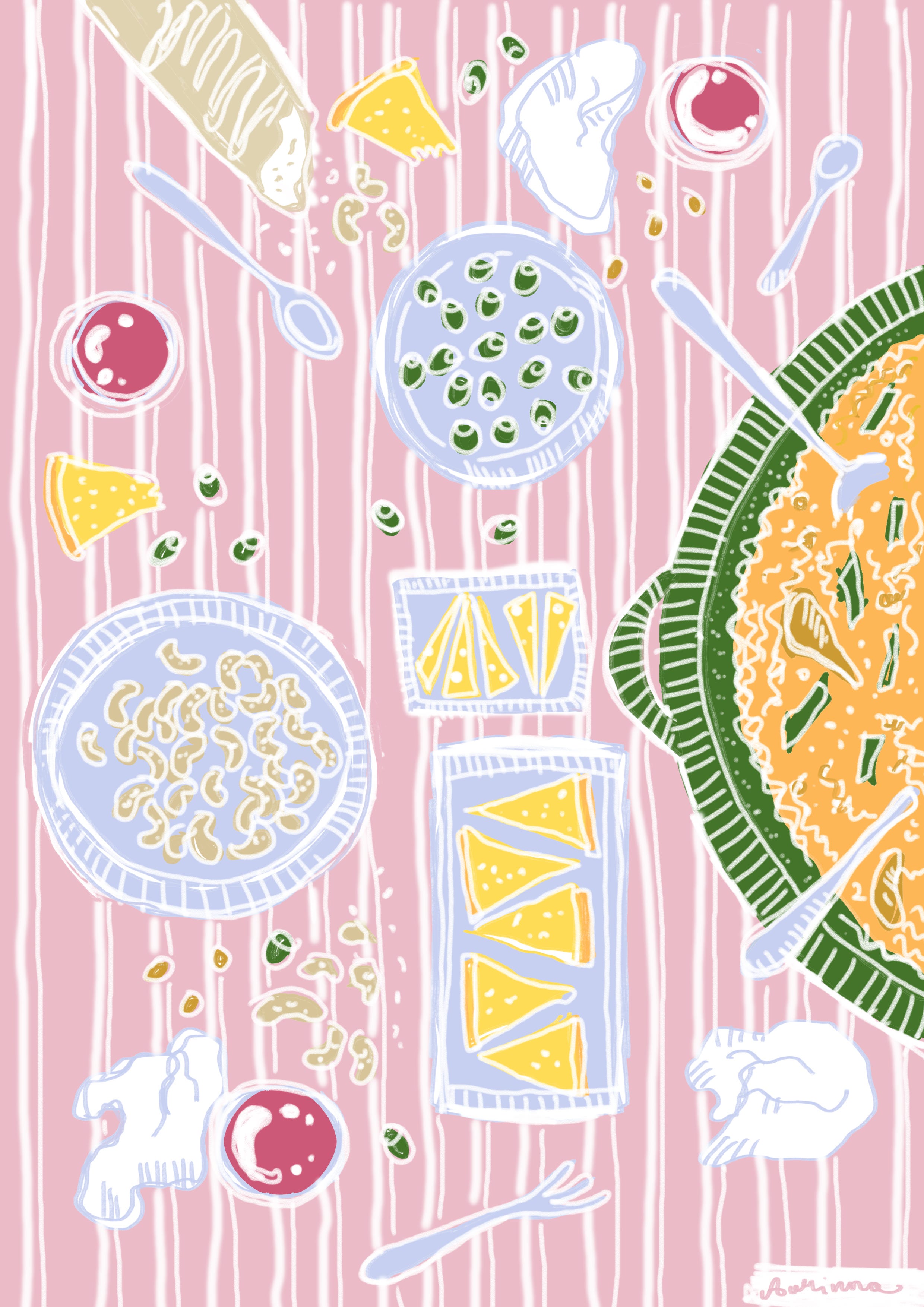
Your typical Valencian party is a huge, slightly chaotic paella that everyone digs into. There are long tables outside with paper tablecloths, bottles of wine and Coke straight on the table. Everyone is snacking on peanuts and olives from paper plates. The dessert is bought from a bakery. It is relaxed, loud, heavy on socialising, laughter, and chat. There are few rules, the point is to have fun and not burden people with too many tasks.
The typical Finnish party is a coffee and cake affair with decent napkins, candles, flowers, and matching decorations. The cakes and quiches are homemade, and genuinely, damn delicious. Everyone brings a gift. The social side is calmer, more regimented, fewer laughs, more talk about work and holidays. It’s a different kind of fun that requires a little more social effort from the guests and a lot more from the host.
And it’s not just the parties. The general sense of what feels enjoyable shows up in smaller details, too. For the Spanish, a big pig’s foot (a jamon that is) is a decent centrepiece for a table. As a Finnish person, I just want a vase. The Spanish housewife will happily dust off her fake plants and wipe crumbs off a plastic tablecloth; as a Northerner, I take pride in things being “real”. When the Spanish go to the beach or have a park picnic, they will bring everything but the kitchen sink, coolers, chairs, tents, all in plastic and an array of bright colours. I want a cotton towel and a stripy umbrella, and for things to match.
For the Spanish, a lot of enjoyment comes from effortlessness, hedonistic pleasures, and the company of others. For the Finnish, it’s about making an effort, purposefulness, and contained aesthetics. Relaxed vs. laboured, open-ended vs. contained, sensory pleasure vs. aesthetic control. We are on the opposite ends of all of these spectrums.
And how will it work
I don’t think this kind of friction can ever be polished away. Understanding where it comes from, the traditions, the weather patterns, the darkness vs the light, doesn’t dissolve it. I will still want flowers and candles at my parties. My partner will still find the idea of an 8 pm dip in cool lake water a bit weird.
I actually think the answer is literally like being bilingual. You will have two different languages of enjoyment in the same household; sometimes you speak one, sometimes the other. The person who is not speaking their mother tongue is going to struggle a little, search for words, and not feel fully like themselves.
Speaking several languages is uncomfortable, yes. But it also gives you so much more vocabulary, words with more specific meanings, feelings you couldn’t have named before. You don’t stop feeling the friction. But you get better at speaking both languages, little by little.
And then maybe the next generation will be fluent in both. Or create their own language of perfect balance.
Tip of the week: Change timing slightly
If you want to test your own flexibility on rhythm, pick one day to be slightly off your own norm. Have lunch two hours later or dinner an hour early. Have a shower in the morning instead of the evening. Have a morning snack instead of an afternoon snack.
And then observe, does it irritate you? Are you indifferent? What feelings does a change of routine bring?
Wishing you lots of love and light from the Haus of Weis, Aurinna
Your subscription keeps the lights on in the Haus of Weis. Subscribe to get domestic insights into your inbox every other Wednesday.
I have lived in a couple of different countries (one of them Spain) and was married to a German. It's true that the differences can be startling but I also love them. Double (or more!) the possible vocabulary for swear words, double the idioms, double the high days and holidays.
And it's *always* time for ice cream. I thought everyone knew that??
I really enjoyed this! My husband is German and we live in the US. I’ve notified this for us when we celebrate the holidays, particularly Christmas. Something we didn’t really consider before we had kids! It definitely does make you sit and have convos around what traditions you want to take from each side and how to blend things in a way that makes sense for your family.
So I understand the tension that incorporating different cultures can bring up! Thanks so much for sharing!